Remembering Mario Bunge: The Public Intellectual Who Tackled Big Questions
Remembering Mario Bunge: The Public Intellectual Who Tackled Big Questions By Heinz W. DrostePublished on September 21, 2026 On September 21, the international scientific and philosophical community marks the birthday of Mario Augusto Bunge (September 21, 1919 – February 24, 2020). On the occasion of his 100th birthday, I had the privilege of contributing a chapter entitled „Mario Bunge as a Public Intellectual“ to his centenary festschrift, Mario Bunge: A Centenary Festschrift (edited by Michael R. Matthews and published by Springer). Today, as we reflect on his legacy, Bunge’s uncompromising defense of rationalism, scientific realism, and social responsibility…
Remembering Mario Bunge: The Public Intellectual Who Tackled Big Questions
By Heinz W. Droste
Published on September 21, 2026
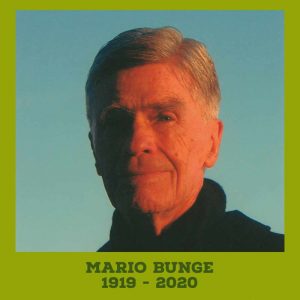
On September 21, the international scientific and philosophical community marks the birthday of Mario Augusto Bunge (September 21, 1919 – February 24, 2020). On the occasion of his 100th birthday, I had the privilege of contributing a chapter entitled „Mario Bunge as a Public Intellectual“ to his centenary festschrift, Mario Bunge: A Centenary Festschrift (edited by Michael R. Matthews and published by Springer). Today, as we reflect on his legacy, Bunge’s uncompromising defense of rationalism, scientific realism, and social responsibility remains as urgent and illuminating as ever.
The Philosopher as a Public Intellectual
What distinguishes Mario Bunge from so many contemporary academic philosophers is that he never retreated into „otherworldly niches“ or settled for merely writing comments on other commentators. Trained as a theoretical physicist and philosopher, Bunge viewed philosophy not as an abstract parlor game, but as an actionable, systemic „truth technology“. This comprehensive framework embraced ontology, epistemology, methodology, ethics, and political philosophy to engage directly with the pressing issues of humanity.
Throughout his long and remarkably prolific career—authoring over 80 books and 500 scientific papers—Bunge operated in the tradition of the radical secular Enlightenment. As early as age 19, he demonstrated his commitment to popular education and social justice by founding the Universidad Obrera Argentina (Argentine Workers’ University) to provide free technical and humanities education to industrial workers.
Whether challenging pseudo-scientific pretensions in academia, confronting Nobel laureates on dualism—such as his famous intervention against Sir John Eccles’ mind-body dualism at the 1978 World Congress of Philosophy in Düsseldorf—or criticizing flawed economic models during global financial crises, Bunge acted as a fearless public intellectual who „took no prisoners“ when fighting for reason.
„A philosophy is worth what it helps learn, act, conserve our common heritage, and get along with fellow humans.“
— Mario Bunge
„The Big Questions Come in Bundles“
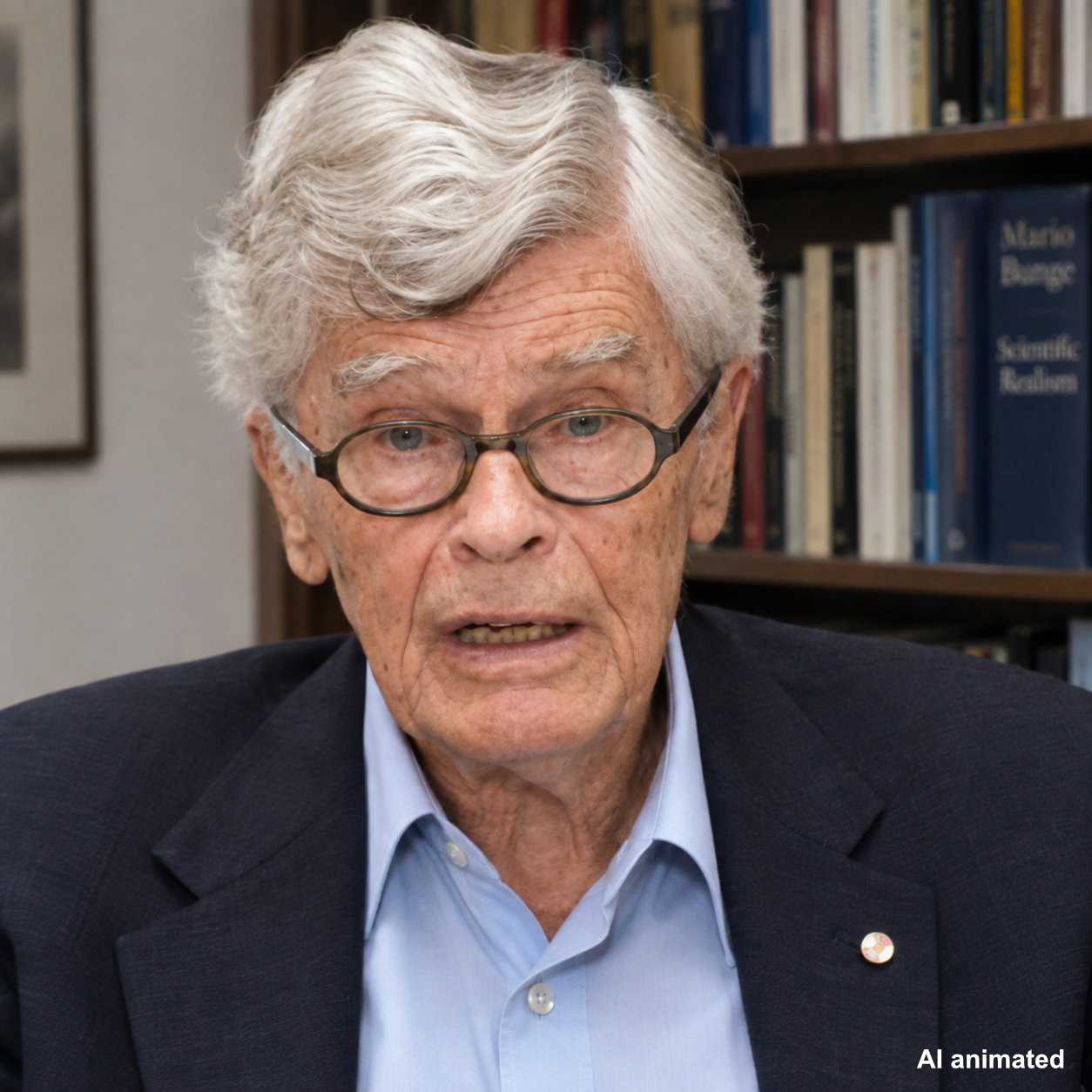
One of Bunge’s core insights is that reality is systemic. Isolated problems are an illusion; genuine scientific and philosophical inquiries are interconnected. As Bunge famously emphasized in our extensive interview:
„The Big Questions come in bundles, not one at a time.“
In this in-depth exchange, Bunge shared his incisive perspectives across a vast spectrum of modern thought:
- On the Role of Philosophy: He rejected „instant philosophy“ or 120-second elevator pitches, arguing that fundamental human issues like truth and justice require rigorous, long-term systemic analysis.
- On Science and Pseudoscience: Bunge provided laymen with clear criteria to spot and reject pseudoscientific fantasies—ranging from psychoanalysis, homeopathy, and acupuncture to uncritical cosmological myths like creation out of nothing or multiverses lacking empirical evidence.
- On Mind, Neuroscience, and Free Will: Grounding his emergent materialism in cognitive neuroscience, Bunge explained how material brain processes support genuine free will through spontaneous neural activity without resorting to non-material mind theories.
- On Modern Technology and Social Bonds: With remarkable foresight, Bunge critiqued the overuse of smartphones and digital devices, warning that text-messaging trivialities undermines authentic face-to-face interaction, which remains essential for love, friendship, and genuine human collaboration.
- On the Enlightenment: He called for a periodic revamping of Enlightenment ideals to tackle modern challenges like technological unemployment and environmental degradation, sharply opposing postmodernists and the Frankfurt School who rejected Enlightenment rationality altogether.
👉 Read the full interview here: Mario Bunge: The Big Questions come in bundles, not one at a time
A Lasting Compass for Rational Thought
As we honor Mario Bunge on his birthday, his work serves as an indispensable compass in an era increasingly threatened by misinformation, irrationalism, and superficial noise Bunge proved that rigorous scientific thinking and passionate public engagement are not mutually exclusive—they are two sides of the same enlightened endeavor.
For those interested in exploring Bunge’s systematic philosophy further, my book Turn of the Tide – Gezeitenwechsel: Einführung in Mario Bunges exakte Philosophie (Pedion Verlag) offers a comprehensive introduction to his exact philosophy.
Let us celebrate Mario Bunge’s enduring legacy by keeping our enthusiasm tempered with caution, planting seeds of rational inquiry, and tackling the big questions with systemic vision.
Categories: Philosophy of Science, Public Intellectuals, Enlightenment, Systemism