
The Dogmatic Slumber Fallacy: Why David Hume Woke Immanuel Kant to Save Faith and Duty, Not Empirical Science
In the annals of Western philosophical history, few anecdotes are quoted with such reverent regularity as Immanuel Kant’s dramatic awakening from his „dogmatic slumber.“ In the preface to his Prolegomena to Any Future Metaphysics (1783), Kant famously made his monumental confession: „I freely admit that the suggestion of David Hume was the very thing which many years ago first interrupted my dogmatic slumber and gave my investigations in the field of speculative philosophy a quite new direction.“ For over two centuries, university curricula and hagiographic biographies have presented this awakening as a heroic turning point in modern intellectual…
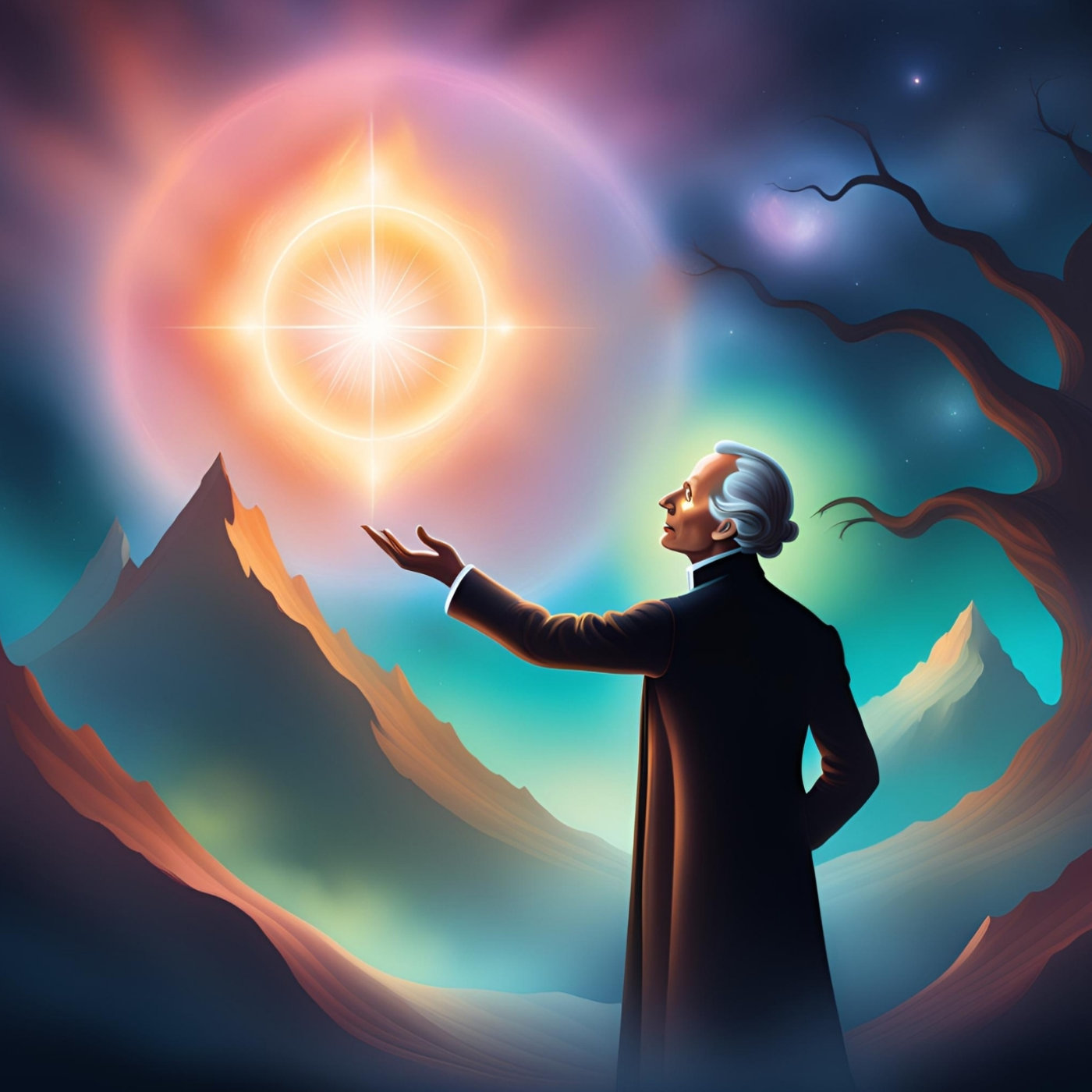
In the annals of Western philosophical history, few anecdotes are quoted with such reverent regularity as Immanuel Kant’s dramatic awakening from his „dogmatic slumber.“ In the preface to his Prolegomena to Any Future Metaphysics (1783), Kant famously made his monumental confession:
„I freely admit that the suggestion of David Hume was the very thing which many years ago first interrupted my dogmatic slumber and gave my investigations in the field of speculative philosophy a quite new direction.“
For over two centuries, university curricula and hagiographic biographies have presented this awakening as a heroic turning point in modern intellectual history. The standard narrative is well-rehearsed: David Hume’s radical Scottish empiricism had allegedly threatened to destroy the objective foundations of natural science and Newtonian causality. Kant, acting as the ultimate savior of reason, supposedly stepped into the breach to construct an unshakeable, a priori foundation that rescued empirical physics from the abyss of total skepticism.
However, when we subject Kant’s intellectual shift to a rigorous, contextualized examination—drawing on modern philosophy of science, historical text analysis, and cognitive science—this noble rescue narrative dissolves into myth. Kant was not awakened by Hume to defend scientific realism; he was deeply alarmed by Hume because empiricism threatened the rational foundation of Lutheran morality, disembodied duty, and theological metaphysics.
Hume’s Radical Challenge: Deconstructing the Metaphysical Scaffold
To understand Kant’s true panic, one must first look at what David Hume actually argued. In his An Enquiry Concerning Human Understanding (1748), Hume subjected the concept of causality to relentless empirical scrutiny. He pointed out that when we observe one physical event following another—such as one billiard ball striking another—we never actually perceive an invisible, necessary metaphysical tie called „causality.“ We merely perceive constant conjunction: one event reliably preceding another in space and time.
From this, Hume deduced that our belief in causal necessity is not derived from pure logic or a priori insights into the essence of reality, but from psychological habit, custom, and associative expectations.
For physical science, Hume’s insight was far from destructive; it was functionally liberating. It reframed scientific laws as empirical hypotheses—fallible, probabilistic models of nature that must be continuously tested, revised, and validated through observation.
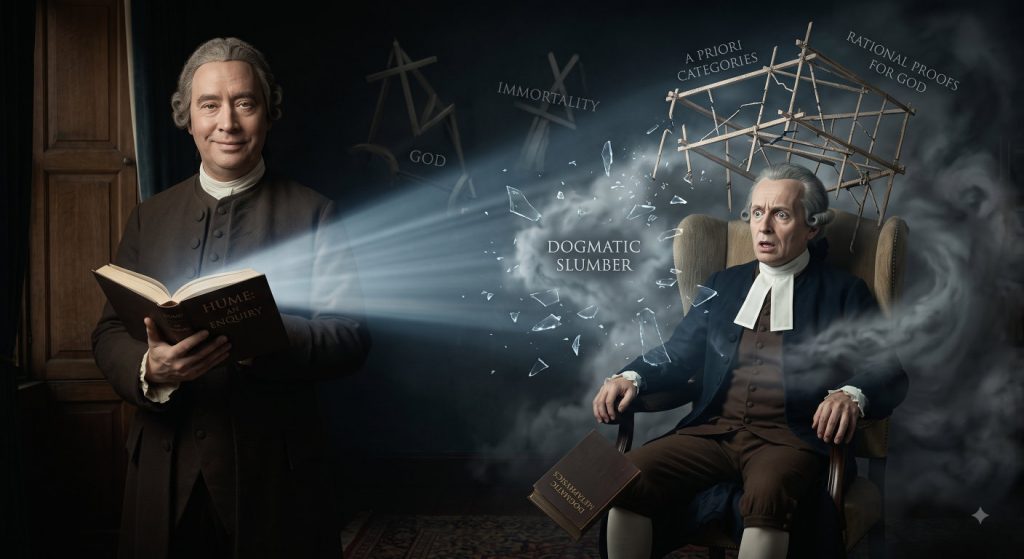
For traditional metaphysics, however, Hume’s empiricism was a fatal catastrophe. If causality could not be proven with absolute, necessary certainty by pure reason alone, then the entire rationalist architecture of Western theology collapsed:
- The classical cosmological proofs for the existence of God (as the „First Cause“) lost their logical necessity.
- The concept of an immortal, immaterial soul detached from physical matter became empirically unprovable.
- Most crucially for Kant, moral duty could no longer be claimed as an absolute, objective law derived from disembodied rational necessity.
The Strategic Counter-Attack: Making Room for Faith
Kant recognized that if Hume’s radical empiricism gained dominance across Europe, philosophy would be stripped of its ability to decree absolute moral imperatives and metaphysical truths. His response was not to embrace empirical scientific realism, but to engineer an elaborate epistemological compromise designed to insulate traditional Lutheran dogmas from empirical refutation.
Kant famously exposed his true underlying agenda in the preface to the second edition of the Critique of Pure Reason (1787):
„I had to deny knowledge in order to make room for faith.“ („Ich musste also das Wissen aufheben, um zum Glauben Platz zu bekommen.“)
This single admission reveals the core driver of the entire Kantian enterprise. Kant’s transcendental framework was deliberately designed to construct an epistemological barrier between human cognition and the material world:
- Internalizing Causality as an A Priori Category: To defeat Hume’s psychological habit argument, Kant declared that causality is neither an objective property of the material world nor an empirical habit. Instead, he claimed it is a mandatory, a priori subjective filter—a synthetic category built directly into the hardwiring of the human mind (Verstandesbegriff).
- Dividing the Cosmos: Phenomena vs. Noumena: By asserting that we can only know phenomena (things as they appear through our subjective cognitive filters), Kant relegated the actual objective world—the „thing-in-itself“ (Ding an sich)—to an unknowable realm of noumena.
- Reinstating God and Free Will as Practical Postulates: Having successfully locked empirical science inside the bounded sphere of subjective appearances, Kant declared the supersensible noumenal realm safe from scientific refutation. In his Critique of Practical Reason (1788), he smuggled God, free will, and the immortality of the soul right back into philosophy—not as empirically verifiable facts, but as non-negotiable „postulates“ required to sustain his rigid, duty-bound moral ethics.
Scientific Realism vs. The Transcendental Trap
When evaluated through the exact philosophy of science pioneered by Mario Bunge, Kant’s „transcendental rescue“ of causality reveals itself as an epistemological step backward.
Modern scientific realism does not require causality to be a subjective human mental filter. Nor does it view the material world as an unknowable „thing-in-itself.“ Objective reality exists independently of human consciousness. Causality, within modern physics and systems theory, is recognized as a real, physical property of energy transformations and structural interactions between physical systems—a property that human beings discover through empirical experimentation and mathematical modeling, not through armchair a priori deduction.
By internalizing causality and declaring external reality unknowable, Kant did not save science from Hume; he trapped European philosophy in a solipsistic, subject-centered bubble. He replaced the open-ended pursuit of empirical truth with a self-contained, dogmatic cognitive prosthesis.
Cognitive Psychology: The Search for Emotional Reassurance
Why did Kant’s solution gain such overwhelming popularity among German academics and intellectuals?
As modern rationality research (such as Keith Stanovich’s work on cognitive biases and the Rationality Quotient) illuminates, human cognition exhibits a strong bias toward structures that provide certainty and reduce existential anxiety. Kant’s philosophy offered an extraordinary psychological comfort: it allowed 18th- and 19th-century intellectuals to pretend they were champions of modern reason, while simultaneously preserving their pietistic moral instincts and religious worldviews intact.
Kant offered a compromise that required no empirical sacrifice. It provided a closed mental scaffolding where duty remained absolute, God remained necessary, and the discomfort of living in a fallback-free, evolving material universe could be comfortably ignored.
What’s Coming Next in Week 4
Next week, in Part 4: The Copernican Revolution or Ptolemaic Relapse?, we will dismantle the central crown jewel of Kant’s epistemology: transcendental idealism. We will explore how Kant’s attempt to place the human mind at the center of the universe was not a revolutionary leap forward, but a reactionary retreat into an 18th-century precursor of „The Matrix.“
Where to Obtain the Book, eBook & AI-Audiobook
The full, evidence-based deconstruction of Immanuel Kant’s scientific, epistemological, and moral legacy is available now across international formats:
- 📚 Paperback Edition: Available via major booksellers and online retailers. 👉 Order the Paperback on Amazon / Booksellers
- 📱 eBook Edition (Kindle / ePub): Instantly downloadable for e-readers and digital libraries. 👉 Get the Digital eBook Edition
- 🎧 AI-Voiced Audiobook (ElevenReader): Listen to the professionally voiced audiobook edition directly on ElevenReader. 👉 Listen to the Audiobook on ElevenReader
- 📰 Press Center & Review Copies: Journalists, reviewers, and podcast hosts can access full press releases, media kits, and sample chapters on the official press page: 👉 Visit the Official Kant Press Center