
Immanuel Kant

  • Kant’s Authoritarian State

    Deconstructing the Mandarin of Königsberg # 7 Over the past six weeks, we have systematically dismantled the intellectual fortress of Immanuel Kant. We have exposed his physical and cosmological errors, stripped away the solipsistic illusion of his transcendental idealism, and revealed the rigid, anti-empirical nature of his duty-bound ethics. We have even uncovered the dark theological trap that led the „Giant of the Enlightenment“ to formulate an explicit hierarchy of intellectual racism. Now, as we approach the conclusion of this series, we must confront the ultimate socio-political fallout of his system: if Kant’s epistemology isolates us from reality…

  • The Theological Trap and the Intellectual Racism of Pure Reason

    Deconstructing the Mandarin of Königsberg, Part 6 For generations, Immanuel Kant has been celebrated as the supreme secular champion of the European Enlightenment. Traditional academic narratives insist that his ethical system is based entirely on pure, objective reason, accessible to any rational being regardless of their religious faith. However, a rigorous textual analysis of Kant’s later writings reveals a profoundly different reality. Kant’s moral framework is deeply entangled in a „God-Bias“—a theological trap that not only compromised his epistemology but ultimately led him to construct a pseudoscientific, racist hierarchy of humanity. The Illusion of Secular Ethics and the…

  • The Categorical Imperative on Trial

    Why Kantian Duty Ethics Collapses in the Face of Moral Psychology and Modern Democracy For more than two centuries, the Categorical Imperative has occupied the throne of Western moral philosophy. Taught in schools, quoted in constitutional court rulings, and invoked in countless Sunday speeches, it is celebrated as the ultimate rational formula for universal justice: „Act only according to that maxim whereby you can at the same time will that it should become a universal law.“ (Groundwork of the Metaphysics of Morals, 1785) The appeal of this formula seems obvious. It promises an objective, disembodied standard of right…

  • The Copernican Revolution Fallacy

    The Ptolemaic Relapse: Why Kant’s „Copernican Revolution“ Is an Epistemological Illusion (and the 18th-Century Matrix) In the Preface to the second edition of the Critique of Pure Reason (1787), Immanuel Kant introduced what is celebrated as the most audacious intellectual maneuver in Western philosophy: „Up to now it has been assumed that all our cognition must conform to the objects […]. Let us once try whether we do not get farther with the problems of metaphysics by assuming that the objects must conform to our cognition.“ (CPR, B XVI) To make this radical inversion palatable, Kant famously compared…

  • The Dogmatic Slumber Fallacy: Why David Hume Woke Immanuel Kant to Save Faith and Duty, Not Empirical Science

    In the annals of Western philosophical history, few anecdotes are quoted with such reverent regularity as Immanuel Kant’s dramatic awakening from his „dogmatic slumber.“ In the preface to his Prolegomena to Any Future Metaphysics (1783), Kant famously made his monumental confession: „I freely admit that the suggestion of David Hume was the very thing which many years ago first interrupted my dogmatic slumber and gave my investigations in the field of speculative philosophy a quite new direction.“ For over two centuries, university curricula and hagiographic biographies have presented this awakening as a heroic turning point in modern intellectual…

  • The Scientific Genius Myth: Did Immanuel Kant Truly Understand Physics?

    In standard histories of Western thought, Immanuel Kant is celebrated not only as a titan of philosophy, but as a groundbreaking scientific visionary. Popular accounts and academic textbooks routinely credit him with two monumental achievements: proposing the nebular hypothesis of solar system formation—commonly dubbed the „Kant-Laplace hypothesis“—and providing the ultimate, irreversible epistemological foundation for Isaac Newton’s classical mechanics. However, when we subject Kant’s physical and cosmological writings to rigorous examination through modern physics, celestial mechanics, and exact philosophy of science, a startling truth comes to light: Kant’s reputation as a scientific genius is largely a retrospective academic construction….

  • The Cognitive Prosthesis: Why We Turn Immanuel Kant into an Intellectual Crutch

    For over two centuries, Western intellectual culture has revered Immanuel Kant as the ultimate lighthouse of the Enlightenment, the undisputed architect of modern reason, and the intellectual father of human autonomy. In academic lecture halls, philosophical treatises, and public commemorations, we are repeatedly taught to recite his three cardinal questions as if they were holy scripture: What can I know? What ought I to do? What may I hope? To the modern educated reader, these three questions sound like a noble, liberating blueprint for human self-determination. But if we dismantle this hagiography through the lens of modern cognitive…

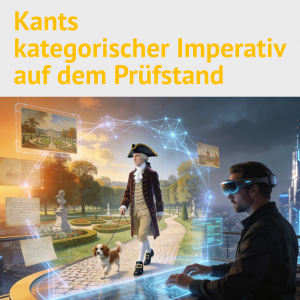
  • Kants kategorischer Imperativ auf dem Prüfstand

    Kants kategorischer Imperativ auf dem Prüfstand Ein philosophischer Streifzug durch 200 Jahre moralischer Selbstüberschätzung Stellen wir uns vor, Sie sitzen beim nächsten Familienfest und jemand fragt in die Runde: „Wer kennt eigentlich Kants kategorischen Imperativ?“ Mindestens drei Hände gehen hoch. Auf Nachfrage wird dann irgendwas genuschelt von „Handle so, dass…“ – und dann bricht die Antwort ab wie eine Straßenbahn, die plötzlich keine Schienen mehr hat. Genau da beginnt das Problem. Denn Kant ist ein Mythos, der sich im kollektiven Bildungsbewusstsein so tief eingenistet hat wie kein anderer Philosoph der westlichen Tradition. Höchste Zeit, diesen Mythos einmal gründlich…

  • Pressematerial

    Über das Buch Immanuel Kant – vermeintlicher Leuchtturm der Aufklärung, angeblicher Architekt der modernen Vernunft, mutmaßlicher Vordenker der Menschenrechte. Zum 300. Geburtstag im Jahr 2024 wurde das deutsche Nationaldenkmal aufwendig gefeiert. Doch was, wenn dieses Bild eine Illusion ist?Heinz W. Droste wagt den frontalen Angriff auf die Mythen, die das Werk des Königsberger Philosophen umgeben. Mit der Präzision des Wissenschaftstheoretikers und dem scharfen Blick des Soziologen demontiert er das Denkgebäude Kants Stück für Stück. Er zeigt: Kants wahres Projekt war nicht die Befreiung des Denkens, sondern die Rettung des lutherischen Glaubens vor der radikalen, materialistischen Aufklärung. Seine Philosophie…

  • Im Schatten Kants – Teil 2: “Der Mandarin von Königsberg“

    „Man kann kein Urtheil über Kant abgeben, ohne in jeder Zeile zu verrathen, welche Welt man im eigenen Kopfe trägt.“ Hermann Cohen, Kants Theorie der Erfahrung, Berlin 1885, S. VII.   „YouTube video player“ von YouTube anzeigen Hier klicken, um den Inhalt von YouTube anzuzeigen. Erfahre mehr in der Datenschutzerklärung von YouTube (öffnet in neuem Tab). Bitte aktiviere JavaScript in deinem Browser, um diesen Inhalt zu laden. Inhalt von YouTube immer anzeigen „YouTube video player“ direkt öffnen     Einleitung Mit der Episode „Im Schatten Kants 1: Der Stein der Weisen“ starteten wir eine kleine Serie über Immanuel…