
Mario Bunge

  • The Categorical Imperative on Trial

    Why Kantian Duty Ethics Collapses in the Face of Moral Psychology and Modern Democracy For more than two centuries, the Categorical Imperative has occupied the throne of Western moral philosophy. Taught in schools, quoted in constitutional court rulings, and invoked in countless Sunday speeches, it is celebrated as the ultimate rational formula for universal justice: „Act only according to that maxim whereby you can at the same time will that it should become a universal law.“ (Groundwork of the Metaphysics of Morals, 1785) The appeal of this formula seems obvious. It promises an objective, disembodied standard of right…

  • The Copernican Revolution Fallacy

    The Ptolemaic Relapse: Why Kant’s „Copernican Revolution“ Is an Epistemological Illusion (and the 18th-Century Matrix) In the Preface to the second edition of the Critique of Pure Reason (1787), Immanuel Kant introduced what is celebrated as the most audacious intellectual maneuver in Western philosophy: „Up to now it has been assumed that all our cognition must conform to the objects […]. Let us once try whether we do not get farther with the problems of metaphysics by assuming that the objects must conform to our cognition.“ (CPR, B XVI) To make this radical inversion palatable, Kant famously compared…

  • The Dogmatic Slumber Fallacy: Why David Hume Woke Immanuel Kant to Save Faith and Duty, Not Empirical Science

    In the annals of Western philosophical history, few anecdotes are quoted with such reverent regularity as Immanuel Kant’s dramatic awakening from his „dogmatic slumber.“ In the preface to his Prolegomena to Any Future Metaphysics (1783), Kant famously made his monumental confession: „I freely admit that the suggestion of David Hume was the very thing which many years ago first interrupted my dogmatic slumber and gave my investigations in the field of speculative philosophy a quite new direction.“ For over two centuries, university curricula and hagiographic biographies have presented this awakening as a heroic turning point in modern intellectual…

  • The Scientific Genius Myth: Did Immanuel Kant Truly Understand Physics?

    In standard histories of Western thought, Immanuel Kant is celebrated not only as a titan of philosophy, but as a groundbreaking scientific visionary. Popular accounts and academic textbooks routinely credit him with two monumental achievements: proposing the nebular hypothesis of solar system formation—commonly dubbed the „Kant-Laplace hypothesis“—and providing the ultimate, irreversible epistemological foundation for Isaac Newton’s classical mechanics. However, when we subject Kant’s physical and cosmological writings to rigorous examination through modern physics, celestial mechanics, and exact philosophy of science, a startling truth comes to light: Kant’s reputation as a scientific genius is largely a retrospective academic construction….

  • The Cognitive Prosthesis: Why We Turn Immanuel Kant into an Intellectual Crutch

    For over two centuries, Western intellectual culture has revered Immanuel Kant as the ultimate lighthouse of the Enlightenment, the undisputed architect of modern reason, and the intellectual father of human autonomy. In academic lecture halls, philosophical treatises, and public commemorations, we are repeatedly taught to recite his three cardinal questions as if they were holy scripture: What can I know? What ought I to do? What may I hope? To the modern educated reader, these three questions sound like a noble, liberating blueprint for human self-determination. But if we dismantle this hagiography through the lens of modern cognitive…

  • Irrwege des Ruhms: Wenn Experten und Intellektuelle in der Krise öffentlich Meinung machen

    Angesichts der Corona-Pandemie hat die internationale Wissenschaftsgemeinschaft beeindruckende Tatkraft bewiesen und in kürzester Zeit große Erkenntnisfortschritte beispielsweise rund um die Wirkmechanismen beim Eindringen in den menschlichen Körper erreicht. Wer etwa Mitglied der American Association for the Advancement of Science (AAAS) – der weltweit größten Wissenschafts-Gesellschaft – ist, konnte anhand des Science-Newsletters und der wöchentlichen Ausgabe des Wissenschafts-Magazins Science just-in-time am ständigen Erkenntniswachstum teilhaben. Die AAAS hatte dazu eine spezielle COVID-19-News-Rubrik eingerichtet, die auch heute am 8. September 2020 ständig aktualisiert in Funktion ist. Einer der Slogans der AAAS lautet „Now is the Time to Listen to Science” –…

  • Obituary: Mario Bunge – Physicist, Philosopher, Champion of Science, and Citizen of the World (1919-2020)

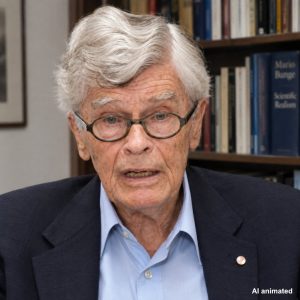
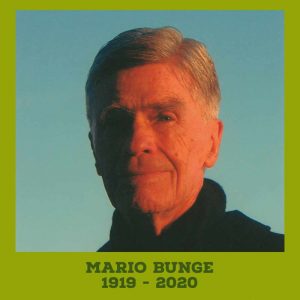
    Mario Bunge, the centenarian Argentine/Canadian physicist/philosopher passed away in the loving company of his wife Marta and children Eric and Silvia on 24th February 2020 in Montreal. Bunge, five years ago, wrote a 500-page autobiography HERE.  By drawing upon his prodigious memory for decades-old readings, events and conversations, it laid out in fascinating detail his personal, family, cultural and scholarly life.  The Memoir is enormously educative and a delight to read.  It has 1,200 entries in its Name Index.  He manages to say something insightful about the life and work of nearly every person mentioned in the Index. …

  • Zum hundertsten Geburtstag: „Mario Bunge: A Centenary Festschrift“

    „Mario Bunge: A Centenary Festschrift“ Der international renommierte Wissenschaftsverlag Springer hat in diesen Tagen den mehr als 800 Seiten umfassenden Band „Mario Bunge: A Centenary Festschrift“ [Matthews, Michael R. (Hg.): Mario Bunge: A Centenary Festschrift, Springer Nature Switzerland: 2019. ] veröffentlicht. Herausgeber ist Michael R. Matthews – Honorarprofessor an der School of Education der University of New South Wales. Worum geht es in dem voluminösen Band? Es handelt sich um die 41 Kapitel umfassende Festschrift zu Ehren Mario Bunges, der in diesem Jahr – am 21. September – seinen 100. Geburtstag feiert. Das Buch, an dem Wissenschaftler aus…

  • Hilfe! – Wir leben in der „Postfaktizität“!

    Seit einiger Zeit ist es in Kreisen bildungsbeflissener Konsumenten überregionaler Feuilletonseiten en vogue, darüber zu diskutieren, wir lebten in postfaktischen Zeiten – eine Perspektive, die als bedrückend empfunden wird. Zum einen bekümmert diese Menschen – mehr oder weniger tiefgründig –, dass Mitbürger – möglicherweise auch sie selbst – sich nicht mehr um Fakten kümmern, sondern vor allem Gefühlen folgen. Parallel schauen sie auf die mediale Präsentation von Politik und vermuten dort die Existenz einer „politischen Postfaktizität“. Worum es sich hierbei handeln soll, bleibt bei Diskussionen um Postfaktizität als politisches Phänomen oft unklar: Ist „Postfaktizität“ tatsächlich ein neues Phänomen?…

  • „Roll over Bertalanffy, tell Parsons and Luhmann the News!“

    System ist nicht gleich System! Was ist spannender als der Mensch? Der bekannte amerikanische Schriftsteller Kurt Vonnegut soll Studenten, die sich für die Geheimnisse des erfolgreichen und fesselnden Schreibens interessierten, erklärt haben, dass es durchaus möglich sei, selbst ein Gebirge spannend zu beschreiben. Es komme nur darauf an, dass in dem dabei entworfenen Bild auch ein Mensch zutage tritt. In der Folge des vorliegenden Beitrags wird es nicht darum gehen, eine spannende Erörterung des Aussehens eines Bergmassivs oder einer anderen geologischen Merkwürdigkeit spannend zu umschreiben – was tatsächlich bereits ein schwierig zu meisterndes Unterfangen wäre. Hier wird es…