
The Copernican Revolution Fallacy
The Ptolemaic Relapse: Why Kant’s „Copernican Revolution“ Is an Epistemological Illusion (and the 18th-Century Matrix) In the Preface to the second edition of the Critique of Pure Reason (1787), Immanuel Kant introduced what is celebrated as the most audacious intellectual maneuver in Western philosophy: „Up to now it has been assumed that all our cognition must conform to the objects […]. Let us once try whether we do not get farther with the problems of metaphysics by assuming that the objects must conform to our cognition.“ (CPR, B XVI) To make this radical inversion palatable, Kant famously compared…

The Ptolemaic Relapse: Why Kant’s „Copernican Revolution“ Is an Epistemological Illusion (and the 18th-Century Matrix)
In the Preface to the second edition of the Critique of Pure Reason (1787), Immanuel Kant introduced what is celebrated as the most audacious intellectual maneuver in Western philosophy:
„Up to now it has been assumed that all our cognition must conform to the objects […]. Let us once try whether we do not get farther with the problems of metaphysics by assuming that the objects must conform to our cognition.“ (CPR, B XVI)
To make this radical inversion palatable, Kant famously compared his paradigm shift to that of Nicolaus Copernicus. When the ancient geocentric system of Ptolemy failed to adequately calculate planetary motions, Copernicus made the observer rotate on Earth while leaving the sun and stars at rest. Similarly, Kant proposed that instead of our minds passively mapping an independent external reality, our subjective cognitive faculties actively construct the objects of experience.
For over two centuries, academic philosophy has hailed this as the „Copernican Revolution in Epistemology“. But when we inspect Kant’s transcendental architecture through the lens of modern philosophy of science and cognitive neuroscience, an astonishing realization takes shape: Kant did not execute a Copernican revolution at all. He executed a regressive, solipsistic retreat—a metaphysical Ptolemaic Relapse.
The Grand Inversion: Copernicus De-Centered, Kant Re-Centered
The core flaw of the „Copernican“ branding lies in a fundamental contradiction between what Copernicus actually accomplished and what Kant attempted:
- Copernicus‘ True Breakthrough: Copernicus achieved an objective de-centering of humanity. He removed the terrestrial observer from the focal point of the cosmos and forced human beings to recognize that the universe does not revolve around them. He aligned human thought with an objective astronomical reality that exists independently of the observer.
- Kant’s Regressive Counter-Move: Kant did the exact opposite. He executed a radical metaphysical re-centering of the subjective observer. He stripped the external, physical universe of its objective reality and placed the human cognitive apparatus (Verstand) back at the absolute center of the experiential cosmos.
Under Kant’s transcendental idealism, the sun, the planets, and all material objects no longer possess independent physical reality in space and time. Instead, they are reduced to subjective appearances (phenomena) synthesized inside the human consciousness.
This is not a progressive step forward into scientific modernity; it is a retreat into a subject-centered, anthropocentric bubble—a philosophical return to Ptolemaic self-absorption.

The Three Deductions: Engineering the Solipsistic Fortress
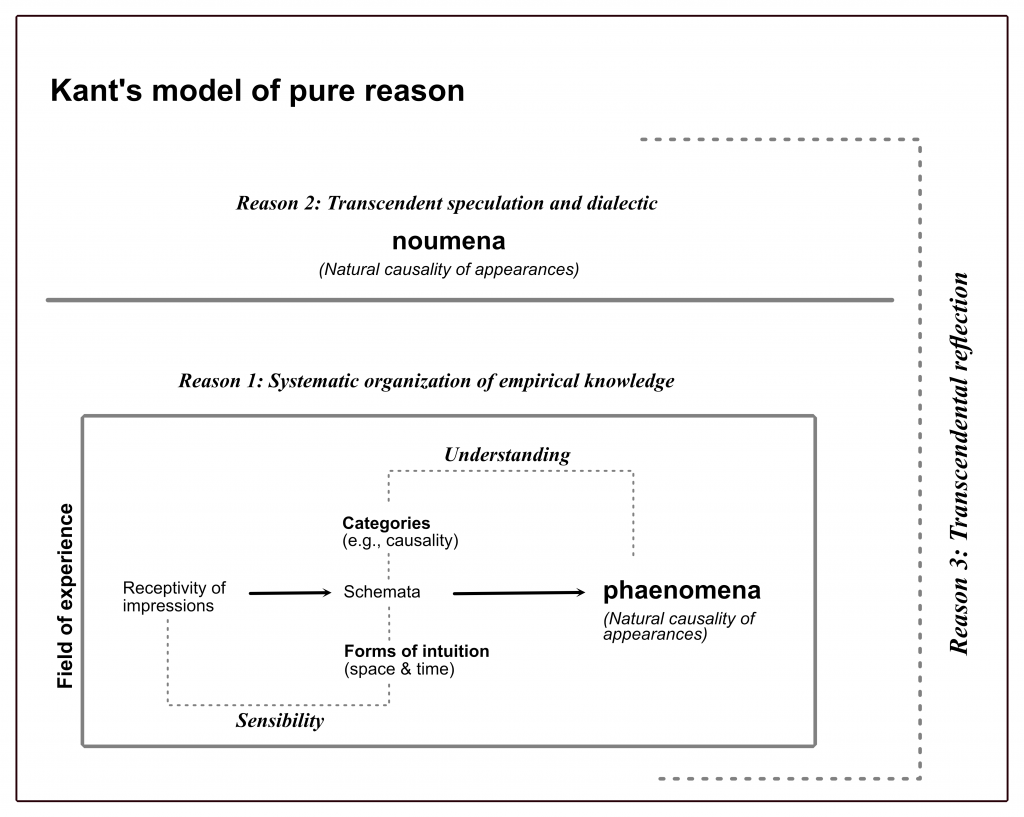
To justify his claim that the objective world conforms to human thought, Kant built the intricate machinery of the Transcendental Analytic. As detailed in Chapter 7 of The Long Farewell to Immanuel Kant, his system stands or falls on three interwoven deductions:
- The Metaphysical Deduction: Kant attempts to deduce twelve pure categories of the understanding (including causality, substance, and modality) directly from traditional table of logical judgments, asserting they are universal, immutable thought-forms.
- The Transcendental Deduction: Kant introduces the transcendental unity of apperception (the synthetic „I think“ that must accompany all representations). He claims that we can only experience objects because the understanding actively synthesizes raw sensory impressions using these categories.
- The Subjective Deduction: Kant bridges abstract categories and raw sensory intuitions via the transcendental schema and the pure a priori forms of space and time.
The Missing Link: The Abolition of Epistemology
What happens to the external, physical world in this construction? It vanishes.
Kant rejects the correspondence theory of truth (the foundational premise that our thoughts attempt to map an objectively existing material world). External reality is degraded into an indeterminate, unknowable limiting concept—a mere „Transcendental Object ‚X'“ that cannot even be said to cause our sensations, because causality is declared to exist solely inside our human understanding.
As Kant’s contemporary, the philosopher Friedrich Heinrich Jacobi, pointed out as early as 1787, Kant’s system is a radical form of subjective solipsism:
„In a double witch’s smoke […] haunting appearances that allow nothing to appear.“
Jacobi recognized the central paradox: without the assumption of real external things affecting our senses, one cannot enter Kant’s system; but with that assumption, one cannot remain inside it without destroying its central logic.
The 18th-Century Matrix
To modern readers, Kant’s abstract transcendental machinery can seem bafflingly detached from reality. Yet pop culture provides an uncanny narrative analogy for the world Kant built: The Matrix.
In the famous science-fiction film series, human beings live inside a total simulation generated by computer code. They perceive buildings, skies, and physical laws, but these are mere computational projections.
Kant’s transcendental philosophy functions identically:
- Space and time are the internal graphic rendering engines of human sensibility.
- The categories of understanding (causality, substance) act as internal algorithms structuring the data feed.
- The experienced world (phenomena) is entirely synthesized within our consciousness.
Crucially, however, the Wachowskis’ cinematic Matrix allows for a „red pill“—an escape into the real, physical world. Kant’s philosophy offers no such exit. By design, Kant traps human reason inside its own subjective simulation forever, forbidding any cognitive access to objective material reality.
The Neuroscientific Refutation: The Dynamic, Predictive Brain
Why must 21st-century science and philosophy bid a definitive farewell to this Kantian construct? Because modern cognitive neuroscience and evolutionary biology have fundamentally disproven Kant’s static, subjectivist model.
Under modern Predictive Processing models of cognition (as articulated in contemporary computational neuroscience and rationality research):
- The Brain is Not an A Priori Mold: The human brain does not impose rigid, innate a priori categories onto experience. Instead, it functions as a hierarchical Bayesian prediction machine. It continuously generates probabilistic hypotheses about external reality, compares them against incoming sensory data from the environment, calculates prediction errors, and updates its internal neural models accordingly.
- Realism Through Adaptation: Our representations of space, time, and causality are not disembodied mental filters. They are evolved, neurocomputational models that have adapted over millions of years of biological evolution to mirror the statistical regularities of an objective, physical world.
- Emergent Selfhood: The „I think“ is not a static transcendental point of apperception, but an emergent biological process arising from dynamic interactions across the Default Mode Network (DMN) and Central Executive Network (CEN) in the prefrontal cortex.
Cognition is not an inside-out construction of the universe; it is a bidirectional, continuous, self-correcting dialogue between an embodied organism and an objective material reality.
The Tragic Trade-Off: Sacrificing Reality for Moral Dogma
Why did Kant go to such extraordinary lengths to construct this solipsistic labyrinth?
As we saw in previous weeks, Kant’s primary motivation was never pure epistemology. He was determined to reconcile two warring principles: unbroken natural causality (to satisfy Newtonian mechanics) and transcendental human freedom (to safeguard Lutheran moral duty).
To resolve this tension, Kant split the human being into two irreconcilable halves:
- The Empirical Character: Fully determined by natural laws, physics, and biology (belonging to phenomena).
- The Intelligible Character: Completely free, timeless, and autonomous (belonging to noumena).
The price of this artificial compromise was catastrophic. In the Dialectic of the first Critique, Kant was forced to draw the devastating conclusion:
„The actual morality of actions (merit and guilt), even that of our own conduct, remains therefore entirely hidden from us.“ (CPR, A 551 / B 579)
By divorcing human freedom from the physical universe, Kant rendered moral autonomy empirically unverifiable and practically inaccessible. He sacrificed our connection to the objective material world, only to leave us with an empty, disembodied shadow of morality.
Escaping the Solipsistic Bubble
The verdict of modern scientific realism is unmistakable: Kant’s „Copernican Revolution“ was a profound misnomer that led Western philosophy down the dead-end street of subjective idealism.
True Enlightenment in the 21st century requires the courage to dismantle this cognitive prison. We do not construct the universe from pure reason. We are embodied biological organisms exploring, testing, and understanding a real, evolving material reality.
Next week in Part 5: The Categorical Imperative on Trial—we examine why Kant’s duty-ethics collapses when confronted with Jonathan Haidt’s moral psychology and Mario Bunge’s Agathonic ethics.
Where to Obtain the Book, eBook & AI-Audiobook
The full, evidence-based deconstruction of Immanuel Kant’s scientific, epistemological, and moral legacy is available now across international formats:
- 📚 Paperback Edition: Available via major booksellers and online retailers. 👉 Order the Paperback on Amazon / Booksellers
- 📱 eBook Edition (Kindle / ePub): Instantly downloadable for e-readers and digital libraries. 👉 Get the Digital eBook Edition
- 🎧 AI-Voiced Audiobook (ElevenReader): Listen to the professionally voiced audiobook edition directly on ElevenReader. 👉 Listen to the Audiobook on ElevenReader
- 📰 Press Center & Review Copies: Journalists, reviewers, and podcast hosts can access full press releases, media kits, and sample chapters on the official press page: 👉 Visit the Official Kant Press Center