
The Categorical Imperative on Trial
Why Kantian Duty Ethics Collapses in the Face of Moral Psychology and Modern Democracy For more than two centuries, the Categorical Imperative has occupied the throne of Western moral philosophy. Taught in schools, quoted in constitutional court rulings, and invoked in countless Sunday speeches, it is celebrated as the ultimate rational formula for universal justice: „Act only according to that maxim whereby you can at the same time will that it should become a universal law.“ (Groundwork of the Metaphysics of Morals, 1785) The appeal of this formula seems obvious. It promises an objective, disembodied standard of right…

Why Kantian Duty Ethics Collapses in the Face of Moral Psychology and Modern Democracy
„Act only according to that maxim whereby you can at the same time will that it should become a universal law.“ (Groundwork of the Metaphysics of Morals, 1785)
The Architecture of Duty: The „Fact of Reason“ Escape Hatch
-
-
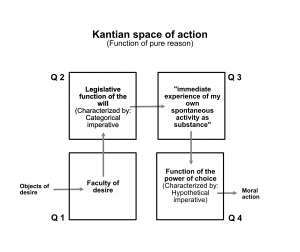
The Metaphysical Deduction: Kant strips the human will of all empirical desires, material goals, and anticipated consequences. He asserts that if a moral law is to hold unconditionally, it cannot depend on „matter“ (such as human happiness or utility), but solely on the purely formal principle of universal legislation.
- The Transcendental Deduction: Having realized that theoretical reason cannot empirically prove human freedom, Kant performs an abrupt methodological leap. He introduces the „Fact of Reason“ (Faktum der Vernunft)—an undeniable inner consciousness of moral obligation („You ought, therefore you can!“). Instead of proving freedom, Kant treats the sense of duty as an unchallengeable axiom that supposedly proves our transcendental autonomy.
- The Subjective Deduction: To explain how a disembodied formal law can motivate flesh-and-blood human beings, Kant invents a unique, non-empirical emotion: Respect for the Law (Achtung fürs Gesetz). This feeling is strictly punitive: it functions primarily to humiliate our natural inclinations and crush our biological desires.
-
- Through this intricate maneuver, Kant created an ethics of absolute moral rigorism. An action possesses moral worth only if it is performed strictly „from duty“ (aus Pflicht). If an action is motivated by empathy, compassion, love, or the desire to prevent suffering, Kant demotes it to mere „inclination“ (Neigung) devoid of genuine moral value.
The Lutheran DNA of Deontology: Inward Freedom, Outward Submission
-
-
The Divided Self: Just as Martin Luther divided the human being into the „inner spiritual person“ (free in faith) and the „outer bodily person“ (bound in total subjection to worldly authority), Kant split humanity into the intelligible character (free in the noumenal realm) and the empirical character (determined by natural necessity).
-
The Fetish of Inwardness: By placing true morality entirely within the pure, disembodied disposition (Gesinnung), external political and social conditions are rendered secondary. The individual achieves „transcendental autonomy“ in their private conscience while remaining a compliant, obedient subject to the ruling sovereign.
-
Contrasting the Western Enlightenment: While the French philosophes (Diderot, Baron d’Holbach) and Anglo-American thinkers (John Locke, Thomas Paine) defined morality through political emancipation, human well-being, and resistance to tyranny, Kant demanded unconditional obedience to duty and explicitly rejected the right to resist despotic state power.
-
- Kantian deontology was custom-tailored for the Prussian barracks state: it trained citizens to fulfill their assigned duties without questioning authority or calculating real-world outcomes.
The Empirical Refutation: Jonathan Haidt’s Moral Psychology
„The Intuitive Dog and Its Rational Tail“
-
-
System 1 (The Intuitive Elephant): Moral judgments are made rapidly, automatically, and emotionally within milliseconds, driven by evolved evolutionary intuitions (care, fairness, loyalty, authority, sanctity).
-
-
-
System 2 (The Rational Tail): Conscious rational reasoning does not generate the moral decision. Instead, it acts like a press secretary, fabricating post-hoc justifications to rationalize decisions that were already made intuitively.
-
-
-
Moral Dumbfounding: When individuals are confronted with scenarios where their rational arguments are systematically dismantled, they do not abandon their moral judgment; they stubbornly maintain it while admitting they cannot explain why.
-
The Danger to Democracy: Consequentialism vs. Ideological Rigorism
-
-
Democracy Demands Consequentialism: Democratic citizens cannot afford to be disembodied „ideological zealots“ (Gesinnungstäter) who enforce abstract rules regardless of the human cost. Mature democratic deliberation requires evaluating real-world outcomes, weighing competing interests, and protecting concrete human well-being.
-
-
-
The Agathonic Alternative: As the Argentine-Canadian philosopher of science Mario Bunge argued in his exact philosophy, we must replace Kant’s one-sided duty-fetish with Agathonism:
„Enjoy life and help live.“
-
Bidding Farewell to the Dictatorship of Duty
Next week in Part 6:
Where to Obtain the Book, eBook & AI-Audiobook
The full, evidence-based deconstruction of Immanuel Kant’s scientific, epistemological, and moral legacy is available now across international formats:
- 📚 Paperback Edition: Available via major booksellers and online retailers. 👉 Order the Paperback on Amazon / Booksellers
- 📱 eBook Edition (Kindle / ePub): Instantly downloadable for e-readers and digital libraries. 👉 Get the Digital eBook Edition
- 🎧 AI-Voiced Audiobook (ElevenReader): Listen to the professionally voiced audiobook edition directly on ElevenReader. 👉 Listen to the Audiobook on ElevenReader
- 📰 Press Center & Review Copies: Journalists, reviewers, and podcast hosts can access full press releases, media kits, and sample chapters on the official press page: 👉 Visit the Official Kant Press Center