
The Scientific Genius Myth: Did Immanuel Kant Truly Understand Physics?
In standard histories of Western thought, Immanuel Kant is celebrated not only as a titan of philosophy, but as a groundbreaking scientific visionary. Popular accounts and academic textbooks routinely credit him with two monumental achievements: proposing the nebular hypothesis of solar system formation—commonly dubbed the „Kant-Laplace hypothesis“—and providing the ultimate, irreversible epistemological foundation for Isaac Newton’s classical mechanics. However, when we subject Kant’s physical and cosmological writings to rigorous examination through modern physics, celestial mechanics, and exact philosophy of science, a startling truth comes to light: Kant’s reputation as a scientific genius is largely a retrospective academic construction….
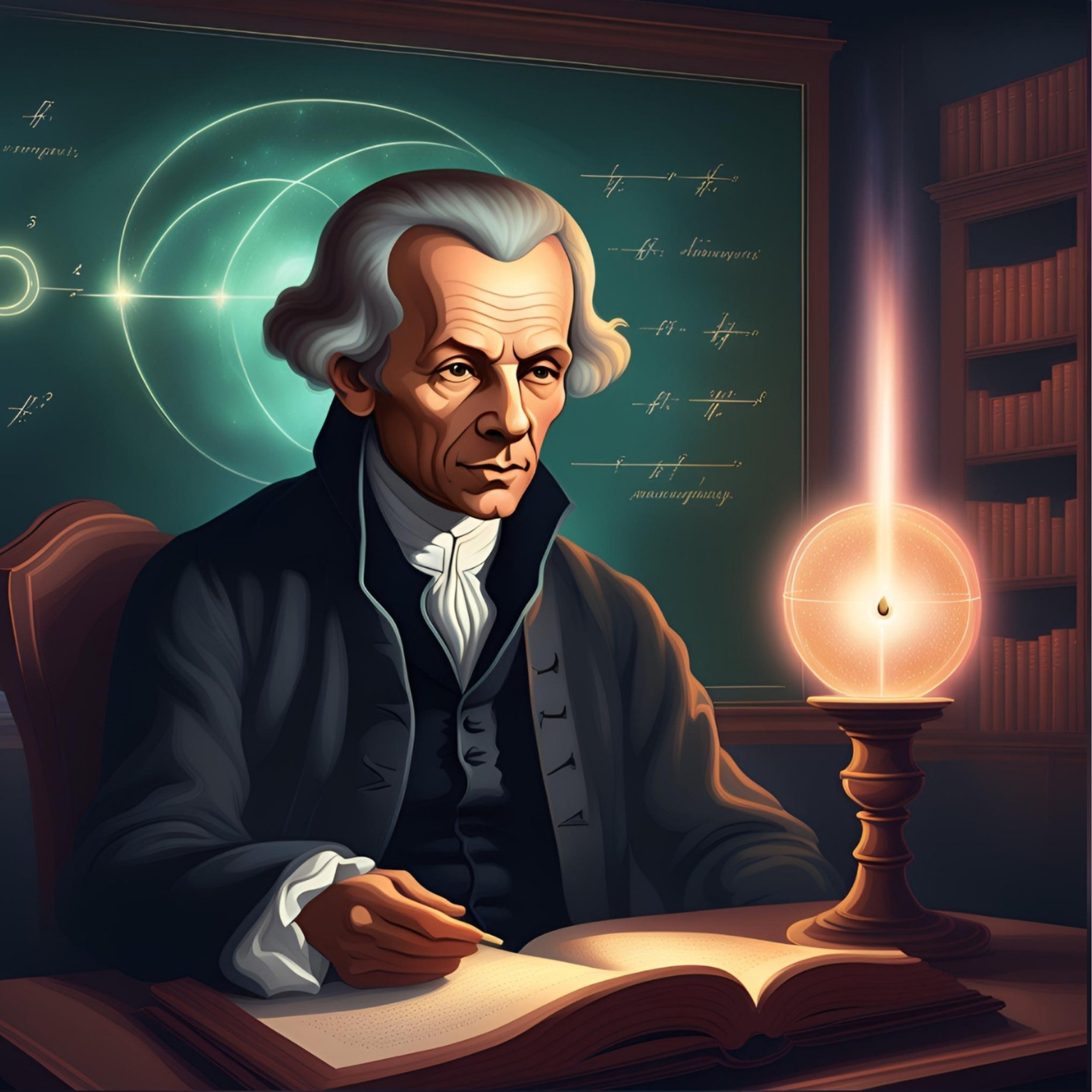
In standard histories of Western thought, Immanuel Kant is celebrated not only as a titan of philosophy, but as a groundbreaking scientific visionary. Popular accounts and academic textbooks routinely credit him with two monumental achievements: proposing the nebular hypothesis of solar system formation—commonly dubbed the „Kant-Laplace hypothesis“—and providing the ultimate, irreversible epistemological foundation for Isaac Newton’s classical mechanics.
However, when we subject Kant’s physical and cosmological writings to rigorous examination through modern physics, celestial mechanics, and exact philosophy of science, a startling truth comes to light: Kant’s reputation as a scientific genius is largely a retrospective academic construction.
The Cosmology Myth: Speculation Without Mathematics
In 1755, the young Kant anonymously published his Universal Natural History and Theory of the Heavens. In this ambitious work, he attempted to explain the origin and mechanical evolution of the universe from a primeval dust cloud, relying solely on attractive and repulsive forces. While literary figures have praised this as a brilliant intuitive leap, Kant’s physical model suffered from fatal scientific flaws.
Unlike the mathematician Pierre-Simon Laplace, who independently formulated a mathematically coherent nebular hypothesis four decades later based on fluid dynamics and Newtonian mechanics, Kant lacked advanced mathematical training. Crucially, Kant’s physical reasoning violated fundamental conservation principles of physics—most notably the law of conservation of angular momentum.
Kant mistakenly assumed that a completely stationary cloud of particles, interacting purely through internal gravitational attraction, could spontaneously induce a net rotation of the entire system. In Newtonian mechanics, an isolated physical system cannot generate net angular momentum from internal central forces alone. What Kant presented was not a rigorous mathematical-physical theory, but a speculative natural philosophy (Naturphilosophie) disguised as Newtonian physics.
Subjugating Physics to Transcendental Dogma
In his later critical phase, particularly in Metaphysical Foundations of Natural Science (1786), Kant sought to „anchor“ physics by deriving Newton’s laws from pure a priori concepts of reason.
Instead of opening physics to empirical revision, Kant’s transcendental framework erected significant barriers to future scientific discovery:
- The Euclidean Space Trap: Kant declared Euclidean space and absolute time to be necessary, unalterable a priori forms of human intuition. Rather than anticipating modern physics, this dogmatic framing actively hindered the conceptual acceptance of non-Euclidean geometries and, ultimately, Albert Einstein’s theory of relativity.
- Dynamism vs. Atomic Science: Kant rejected atomic theory and insisted on reducing matter entirely to continuously distributed attractive and repulsive forces. This speculative „dynamism“ disconnected Kantian philosophy from the developing empirical chemistry and molecular theory of the 19th century.
- A Priori Deduction vs. Scientific Realism: For Isaac Newton, physical principles were hypotheses subject to mathematical formulation and empirical testing. For Kant, physics had to be subjugated to transcendental philosophy.
Scientific Realism vs. Idealist Hagiography
Why has the image of Kant as a scientific polymath endured for over two centuries?
Because the 19th-century German idealist tradition required an iconic figurehead who could bridge hard natural science and traditional metaphysics. By portraying Kant as the thinker who „understood Newton better than Newton understood himself,“ academic philosophy attempted to assert its dominance over the rising empirical sciences.
As I demonstrate in The Long Farewell to Immanuel Kant—drawing on the exact philosophy of science developed by Mario Bunge—real scientific progress does not stem from constructing a priori armchair theories. Science demands scientific realism: an ongoing, self-correcting dialogue between mathematical modeling and empirical testing, free from metaphysical dogmas that claim to know the nature of reality prior to experience.
Coming Up Next in Week 3
Next week, we examine one of the most famous anecdotes in intellectual history: Kant’s claim that reading David Hume „interrupted his dogmatic slumber.“ We will reveal why Hume’s skepticism alarmed Kant primarily for theological and moral reasons—not scientific ones.
It is time to discard the cognitive prosthesis and rediscover an unencumbered, evidence-based Enlightenment fit for the challenges of the 21st century.
Where to Obtain the Book, eBook & AI-Audiobook

The full, uncompromised investigation is available now across international formats:
- 📚 Paperback Edition: Available via major booksellers and online retailers. 👉 Order the Paperback on Amazon / Booksellers
- 📱 eBook Edition (Kindle / ePub): Instantly downloadable for e-readers and digital libraries. 👉 Get the Digital eBook Edition
- 🎧 AI-Voiced Audiobook (ElevenReader): Listen to the professionally voiced audiobook edition directly on ElevenReader. 👉 Listen to the Audiobook on ElevenReader
- 📰 Press Center & Review Copies: Journalists, reviewers, and podcast hosts can access full press releases, media kits, and sample chapters on the official press page: 👉 Visit the Official Kant Press Center