
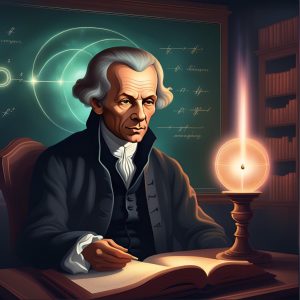
The Scientific Genius Myth: Did Immanuel Kant Truly Understand Physics?
In standard histories of Western thought, Immanuel Kant is celebrated not only as a titan of philosophy, but as a groundbreaking scientific visionary. Popular accounts and academic textbooks routinely credit him with two monumental achievements: proposing the nebular hypothesis of solar system formation—commonly dubbed the „Kant-Laplace hypothesis“—and providing the ultimate, irreversible epistemological foundation for Isaac Newton’s classical mechanics. However, when we subject Kant’s physical and cosmological writings to rigorous examination through modern physics, celestial mechanics, and exact philosophy of science, a startling truth comes to light: Kant’s reputation as a scientific genius is largely a retrospective academic construction….