
The Categorical Imperative on Trial

Why Kantian Duty Ethics Collapses in the Face of Moral Psychology and Modern Democracy For more than two centuries, the Categorical Imperative has occupied the throne of Western moral philosophy. Taught in schools, quoted in constitutional court rulings, and invoked in countless Sunday speeches, it is celebrated as the ultimate rational formula for universal justice: „Act only according to that maxim whereby you can at the same time will that it should become a universal law.“ (Groundwork of the Metaphysics of Morals, 1785) The appeal of this formula seems obvious. It promises an objective, disembodied standard of right…

Why Kantian Duty Ethics Collapses in the Face of Moral Psychology and Modern Democracy

For more than two centuries, the Categorical Imperative has occupied the throne of Western moral philosophy. Taught in schools, quoted in constitutional court rulings, and invoked in countless Sunday speeches, it is celebrated as the ultimate rational formula for universal justice:


„Act only according to that maxim whereby you can at the same time will that it should become a universal law.“ (Groundwork of the Metaphysics of Morals, 1785)
The appeal of this formula seems obvious. It promises an objective, disembodied standard of right and wrong that functions independently of emotional whims, cultural traditions, or personal self-interest.

However, when we subject Kant’s practical philosophy to the scrutiny of evolutionary biology, empirical moral psychology, and modern democratic theory, a devastating structural failure is exposed: Kant’s ethics of duty (Deontology) is not a universal foundation for human dignity. It is an empirically refuted, anti-democratic construct rooted in the Lutheran tradition of Prussian subject-obedience.

The Architecture of Duty: The „Fact of Reason“ Escape Hatch


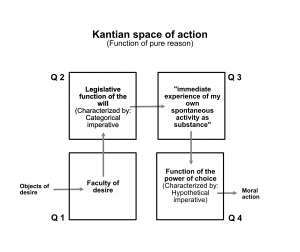
In Chapter 8 of The Long Farewell to Immanuel Kant, we trace how Kant attempted to establish the Categorical Imperative across three distinct deductions in the Critique of Practical Reason (1788):


    1. The Metaphysical Deduction: Kant strips the human will of all empirical desires, material goals, and anticipated consequences. He asserts that if a moral law is to hold unconditionally, it cannot depend on „matter“ (such as human happiness or utility), but solely on the purely formal principle of universal legislation.

    2. The Transcendental Deduction: Having realized that theoretical reason cannot empirically prove human freedom, Kant performs an abrupt methodological leap. He introduces the „Fact of Reason“ (Faktum der Vernunft)—an undeniable inner consciousness of moral obligation („You ought, therefore you can!“). Instead of proving freedom, Kant treats the sense of duty as an unchallengeable axiom that supposedly proves our transcendental autonomy.

    3. The Subjective Deduction: To explain how a disembodied formal law can motivate flesh-and-blood human beings, Kant invents a unique, non-empirical emotion: Respect for the Law (Achtung fürs Gesetz). This feeling is strictly punitive: it functions primarily to humiliate our natural inclinations and crush our biological desires.
  1. Through this intricate maneuver, Kant created an ethics of absolute moral rigorism. An action possesses moral worth only if it is performed strictly „from duty“ (aus Pflicht). If an action is motivated by empathy, compassion, love, or the desire to prevent suffering, Kant demotes it to mere „inclination“ (Neigung) devoid of genuine moral value.

The Lutheran DNA of Deontology: Inward Freedom, Outward Submission

Why did Kant construct such an austere, anti-hedonic framework?

The answer lies in the religio-sociological roots of the Prussian state. Kant’s moral theory is a secularized translation of Lutheran Protestantism:

    • The Divided Self: Just as Martin Luther divided the human being into the „inner spiritual person“ (free in faith) and the „outer bodily person“ (bound in total subjection to worldly authority), Kant split humanity into the intelligible character (free in the noumenal realm) and the empirical character (determined by natural necessity).

    • The Fetish of Inwardness: By placing true morality entirely within the pure, disembodied disposition (Gesinnung), external political and social conditions are rendered secondary. The individual achieves „transcendental autonomy“ in their private conscience while remaining a compliant, obedient subject to the ruling sovereign.

    • Contrasting the Western Enlightenment: While the French philosophes (Diderot, Baron d’Holbach) and Anglo-American thinkers (John Locke, Thomas Paine) defined morality through political emancipation, human well-being, and resistance to tyranny, Kant demanded unconditional obedience to duty and explicitly rejected the right to resist despotic state power.
  • Kantian deontology was custom-tailored for the Prussian barracks state: it trained citizens to fulfill their assigned duties without questioning authority or calculating real-world outcomes.
The Empirical Refutation: Jonathan Haidt’s Moral Psychology


In the 21st century, cognitive science and evolutionary moral psychology have shattered Kant’s rationalist assumptions.


Social psychologist Jonathan Haidt, in his landmark work The Righteous Mind, presents an empirical reality that turns Kant’s model upside down:


„The Intuitive Dog and Its Rational Tail“ 

Haidt’s extensive cross-cultural research demonstrates how moral decision-making actually operates in the human brain:


    • System 1 (The Intuitive Elephant): Moral judgments are made rapidly, automatically, and emotionally within milliseconds, driven by evolved evolutionary intuitions (care, fairness, loyalty, authority, sanctity).

    • System 2 (The Rational Tail): Conscious rational reasoning does not generate the moral decision. Instead, it acts like a press secretary, fabricating post-hoc justifications to rationalize decisions that were already made intuitively.

    • Moral Dumbfounding: When individuals are confronted with scenarios where their rational arguments are systematically dismantled, they do not abandon their moral judgment; they stubbornly maintain it while admitting they cannot explain why.
Kant mistook the „rational tail“ for the „moral dog“. His claim that pure, disembodied reason can independently generate moral action without emotional intuition is an untenable fiction.

The Danger to Democracy: Consequentialism vs. Ideological Rigorism


The most dangerous flaw of Kantian deontology is its systematic disregard for consequences.

In his notorious 1797 essay, „On a Supposed Right to Tell Lies from Benevolent Motives,“ Kant maintained that it is morally forbidden to lie, even to an axe-murderer asking for the location of an innocent friend hiding in your home. For Kant, preserving the formal purity of the universal law overrides saving an actual human life.

In a pluralistic, democratic society, this mindset is fatal:

    • Democracy Demands Consequentialism: Democratic citizens cannot afford to be disembodied „ideological zealots“ (Gesinnungstäter) who enforce abstract rules regardless of the human cost. Mature democratic deliberation requires evaluating real-world outcomes, weighing competing interests, and protecting concrete human well-being.
    • The Agathonic Alternative: As the Argentine-Canadian philosopher of science Mario Bunge argued in his exact philosophy, we must replace Kant’s one-sided duty-fetish with Agathonism:

      „Enjoy life and help live.“
A viable secular ethic must balance individual rights with social responsibilities. It must recognize that duties are meaningless unless they serve to protect real human needs and produce measurable, beneficial consequences for society.
 

Bidding Farewell to the Dictatorship of Duty


The Categorical Imperative claims to be a universal compass, but on closer inspection, it functions as a rigid ideological straitjacket. It disconnects ethics from empathy, ignores empirical human nature, and replaces moral responsibility with blind obedience.


To build an ethical framework fit for the 21st century, we must leave Kantian deontology behind. We need a humanistic, evidence-based ethic that measures moral progress not by the purity of abstract maxims, but by the tangible reduction of suffering and the expansion of real human freedom.

Next week in Part 6:
 
The Theological Trap—how Kant’s „God-Bias“ secretly hijacked the Enlightenment to preserve religious orthodoxy under the guise of pure reason.

Where to Obtain the Book, eBook & AI-Audiobook

The full, evidence-based deconstruction of Immanuel Kant’s scientific, epistemological, and moral legacy is available now across international formats:


Ähnliche Beiträge

  • Pressematerial

    Über das Buch Immanuel Kant – vermeintlicher Leuchtturm der Aufklärung, angeblicher Architekt der modernen Vernunft, mutmaßlicher Vordenker der Menschenrechte. Zum 300. Geburtstag im Jahr 2024 wurde das deutsche Nationaldenkmal aufwendig gefeiert. Doch was, wenn dieses Bild eine Illusion ist?Heinz W. Droste wagt den frontalen Angriff auf die Mythen, die das Werk des Königsberger Philosophen umgeben. Mit der Präzision des Wissenschaftstheoretikers und dem scharfen Blick des Soziologen demontiert er das Denkgebäude Kants Stück für Stück. Er zeigt: Kants wahres Projekt war nicht die Befreiung des Denkens, sondern die Rettung des lutherischen Glaubens vor der radikalen, materialistischen Aufklärung. Seine Philosophie…

  • Mario Bunge im Interview – Die ganz großen Fragen

    21. September 2019 – der Philosoph und Physiker Mario Bunge wird 100 Rückschau – mein Interview mit Mario im Sommer 2013 Im Sommer des Jahres 2013 hatte ich Gelegenheit, Mario Bunge anhand eines umfangreichen Fragenpakets zu seiner realistischen Philosophie und zu dessen Hintergründen zu interviewen. Bevor es gleich in die Aufzeichnung dieses Interviews geht, ist der Augenblick gekommen, die Person des Philosophen zumindest in wesentlichen Zügen vorzustellen. Wer ist dieser Mario Augusto Bunge, über dessen Persönlichkeit wir bisher nicht viel mehr erfahren haben, als dass er im Jahr 1919 – genauer am 21. September 1919 – in Buenos…

  • Obituary: Mario Bunge – Physicist, Philosopher, Champion of Science, and Citizen of the World (1919-2020)

    Mario Bunge, the centenarian Argentine/Canadian physicist/philosopher passed away in the loving company of his wife Marta and children Eric and Silvia on 24th February 2020 in Montreal. Bunge, five years ago, wrote a 500-page autobiography HERE.  By drawing upon his prodigious memory for decades-old readings, events and conversations, it laid out in fascinating detail his personal, family, cultural and scholarly life.  The Memoir is enormously educative and a delight to read.  It has 1,200 entries in its Name Index.  He manages to say something insightful about the life and work of nearly every person mentioned in the Index. …

  • Irrwege des Ruhms: Wenn Experten und Intellektuelle in der Krise öffentlich Meinung machen

    Angesichts der Corona-Pandemie hat die internationale Wissenschaftsgemeinschaft beeindruckende Tatkraft bewiesen und in kürzester Zeit große Erkenntnisfortschritte beispielsweise rund um die Wirkmechanismen beim Eindringen in den menschlichen Körper erreicht. Wer etwa Mitglied der American Association for the Advancement of Science (AAAS) – der weltweit größten Wissenschafts-Gesellschaft – ist, konnte anhand des Science-Newsletters und der wöchentlichen Ausgabe des Wissenschafts-Magazins Science just-in-time am ständigen Erkenntniswachstum teilhaben. Die AAAS hatte dazu eine spezielle COVID-19-News-Rubrik eingerichtet, die auch heute am 8. September 2020 ständig aktualisiert in Funktion ist. Einer der Slogans der AAAS lautet „Now is the Time to Listen to Science” –…

  • So funktioniert Denken selbst am Abgrund!

    Denken in entscheidenden Situationen „Denken ist wichtig.“ wird häufig gesagt. Was hinter dieser, auf unserer Hirntätigkeit basierenden Kompetenz steckt, ist noch nicht komplett erforscht. Dass beim Denken im Rahmen des Treffens von Entscheidungen Einiges schief gehen kann, zeigt sich insbesondere beim Verhalten von Anlegern an der Börse. Als Ende der 90er Jahre das Thema Aktie in Deutschland populär wurde – Manfred Krug machte Werbung für die Telekom-Aktie – wurde auch das Thema Denken intensiv diskutiert. Damals ging es darum, wie Aktienanleger denken und warum sie Aktien kaufen, verkaufen und warum sie sich in Situationen zu spät von Aktien…

  • Im Schatten Kants – Teil 2: “Der Mandarin von Königsberg“

    „Man kann kein Urtheil über Kant abgeben, ohne in jeder Zeile zu verrathen, welche Welt man im eigenen Kopfe trägt.“ Hermann Cohen, Kants Theorie der Erfahrung, Berlin 1885, S. VII.   „YouTube video player“ von YouTube anzeigen Hier klicken, um den Inhalt von YouTube anzuzeigen. Erfahre mehr in der Datenschutzerklärung von YouTube (öffnet in neuem Tab). Bitte aktiviere JavaScript in deinem Browser, um diesen Inhalt zu laden. Inhalt von YouTube immer anzeigen „YouTube video player“ direkt öffnen     Einleitung Mit der Episode „Im Schatten Kants 1: Der Stein der Weisen“ starteten wir eine kleine Serie über Immanuel…

Schreibe einen Kommentar